Obasanjo’s Achievements as President: Nigeria’s Reforms from 1999 to 2007
Politics · Nigerian History | Published 3 October 2026


Olusegun Obasanjo’s civilian presidency helped reshape Nigeria’s telecommunications, banking, pension and public-accountability systems. Some of its most important achievements were changes to institutions and rules that affected how people communicated, saved, worked and accessed public services.
He served from 29 May 1999 to 29 May 2007, covering two four-year terms. This review focuses on that civilian administration. The dates are confirmed by the Presidency’s official record.
1. Securing Paris Club debt relief
One of the administration’s clearest achievements was the 2005–2006 agreement that removed Nigeria’s Paris Club debt burden. The package included about US$18 billion in debt cancellation, alongside substantial payments by Nigeria to settle the remaining obligations. The final payment was made in April 2006.
This was a negotiated settlement involving the economic team and creditor governments—not the cancellation of every Nigerian debt without payment. Its significance was the reduction in external debt and future servicing obligations. Source: Ngozi Okonjo-Iweala’s account in IMF Finance & Development; Debt Management Office documentation.
2. Opening the way for the GSM expansion
The 2001 digital mobile licence auction was a turning point in Nigeria’s telecommunications market. The NCC’s records document the auction, while the Nigerian Communications Act 2003 strengthened the sector’s legal framework.
The achievement was the enabling policy and regulatory environment that supported commercial investment and competition. Private operators built and operated the networks. For households and small businesses, wider mobile access changed the practical possibilities of contacting customers, arranging supplies and staying connected across long distances. Source: NCC auction records; Nigerian Communications Act 2003.
3. Establishing anti-corruption institutions
The ICPC was established under its 2000 Act, and the EFCC began operating in 2003, with its establishment law subsequently revised in 2004. These institutions gave Nigeria dedicated structures for investigating corruption and economic and financial crimes.
Creating enforcement institutions is a measurable contribution. It should not be confused with a claim that corruption disappeared or that every enforcement decision was beyond criticism. Source: ICPC legislative history; EFCC institutional record.
4. Banking-sector consolidation
During his presidency, the Central Bank introduced a major recapitalisation programme in July 2004. Banks were required to meet a minimum capital base of ₦25 billion by the end of 2005, through fresh investment or combinations with other banks.
The CBN reported that 25 banks emerged meeting the requirement at the end of that phase, from an industry previously containing 89 banks. The reform aimed to build stronger institutions capable of supporting larger financial activity. It was a CBN-led programme carried out under Obasanjo’s government; consolidation alone was not a guarantee against future banking problems. Source: CBN’s January 2006 assessment.

5. Pension reform and the creation of PenCom
The Pension Reform Act 2004 introduced a major change in pension administration and established the National Pension Commission. PenCom’s history links the reform to problems including inadequate funding, delayed retirement payments and weaknesses in pension management.
The contribution was a new regulatory and administrative foundation for retirement savings. Its long-term success depended on contributions being remitted, funds being supervised and benefits reaching retirees when due. Source: PenCom.
6. Launching Universal Basic Education
Obasanjo launched the Universal Basic Education programme in Sokoto on 29 September 1999. The UBE Act followed in 2004, providing a legal framework for basic education and federal support for implementation.
UBEC describes the programme as covering six years of primary and three years of junior secondary education. It strengthened the institutional commitment to access and continuity in schooling, while implementation remained dependent on federal, state and local responsibilities. A programme’s establishment should be assessed separately from whether every child actually received quality education. Source: UBEC.
What this record shows
Obasanjo’s 1999–2007 achievements are especially visible in reforms that changed national systems: debt management, communications, banking, pensions, accountability and basic education. Credit belongs both to presidential leadership and to the legislators, regulators, public servants, negotiating teams and private investors who implemented the changes.
This is a selective review of documented achievements, rather than a complete assessment of his presidency. Recognising these contributions leaves room to examine the costs, limitations and wider controversies of the period.
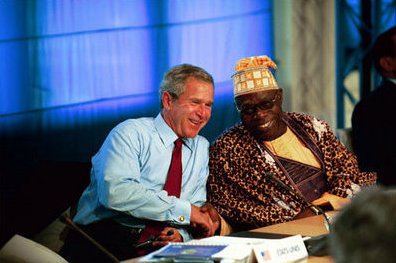
Sources checked on 3 October 2026. Both photographs were taken during Obasanjo’s civilian presidency and are credited above.
Politics · Nigerian History | Published 3 October 2026
Olusegun Obasanjo’s civilian presidency helped reshape Nigeria’s telecommunications, banking, pension and public-accountability systems. Some of its most important achievements were changes to institutions and rules that affected how people communicated, saved, worked and accessed public services.
He served from 29 May 1999 to 29 May 2007, covering two four-year terms. This review focuses on that civilian administration. The dates are confirmed by the Presidency’s official record.
1. Securing Paris Club debt relief
One of the administration’s clearest achievements was the 2005–2006 agreement that removed Nigeria’s Paris Club debt burden. The package included about US$18 billion in debt cancellation, alongside substantial payments by Nigeria to settle the remaining obligations. The final payment was made in April 2006.
This was a negotiated settlement involving the economic team and creditor governments—not the cancellation of every Nigerian debt without payment. Its significance was the reduction in external debt and future servicing obligations. Source: Ngozi Okonjo-Iweala’s account in IMF Finance & Development; Debt Management Office documentation.
2. Opening the way for the GSM expansion
The 2001 digital mobile licence auction was a turning point in Nigeria’s telecommunications market. The NCC’s records document the auction, while the Nigerian Communications Act 2003 strengthened the sector’s legal framework.
The achievement was the enabling policy and regulatory environment that supported commercial investment and competition. Private operators built and operated the networks. For households and small businesses, wider mobile access changed the practical possibilities of contacting customers, arranging supplies and staying connected across long distances. Source: NCC auction records; Nigerian Communications Act 2003.
3. Establishing anti-corruption institutions
The ICPC was established under its 2000 Act, and the EFCC began operating in 2003, with its establishment law subsequently revised in 2004. These institutions gave Nigeria dedicated structures for investigating corruption and economic and financial crimes.
Creating enforcement institutions is a measurable contribution. It should not be confused with a claim that corruption disappeared or that every enforcement decision was beyond criticism. Source: ICPC legislative history; EFCC institutional record.
4. Banking-sector consolidation
During his presidency, the Central Bank introduced a major recapitalisation programme in July 2004. Banks were required to meet a minimum capital base of ₦25 billion by the end of 2005, through fresh investment or combinations with other banks.
The CBN reported that 25 banks emerged meeting the requirement at the end of that phase, from an industry previously containing 89 banks. The reform aimed to build stronger institutions capable of supporting larger financial activity. It was a CBN-led programme carried out under Obasanjo’s government; consolidation alone was not a guarantee against future banking problems. Source: CBN’s January 2006 assessment.
5. Pension reform and the creation of PenCom
The Pension Reform Act 2004 introduced a major change in pension administration and established the National Pension Commission. PenCom’s history links the reform to problems including inadequate funding, delayed retirement payments and weaknesses in pension management.
The contribution was a new regulatory and administrative foundation for retirement savings. Its long-term success depended on contributions being remitted, funds being supervised and benefits reaching retirees when due. Source: PenCom.
6. Launching Universal Basic Education
Obasanjo launched the Universal Basic Education programme in Sokoto on 29 September 1999. The UBE Act followed in 2004, providing a legal framework for basic education and federal support for implementation.
UBEC describes the programme as covering six years of primary and three years of junior secondary education. It strengthened the institutional commitment to access and continuity in schooling, while implementation remained dependent on federal, state and local responsibilities. A programme’s establishment should be assessed separately from whether every child actually received quality education. Source: UBEC.
What this record shows
Obasanjo’s 1999–2007 achievements are especially visible in reforms that changed national systems: debt management, communications, banking, pensions, accountability and basic education. Credit belongs both to presidential leadership and to the legislators, regulators, public servants, negotiating teams and private investors who implemented the changes.
This is a selective review of documented achievements, rather than a complete assessment of his presidency. Recognising these contributions leaves room to examine the costs, limitations and wider controversies of the period.
Sources checked on 3 October 2026. Both photographs were taken during Obasanjo’s civilian presidency and are credited above.